
New Year’s Eve in America is mostly the same everywhere. A countdown. Champagne that costs too much. Fireworks someone filmed on a phone. By January 2, everyone is back at their desk pretending the year did not just reset. It is fine. It is also a bit thin when compared to what Scotland does with the same night.
Hogmanay is the Scottish new year. Not a single evening. A proper multi-day celebration stretching from December 31 into January 2, sometimes January 3 if a town decides midnight on the second is worth marking as well. Through the specialty of kilt and kilts, our brand does not just have a keen understanding of Scottish Clothing but Traditions as well.
Through the street celebration around Edinburgh, there have been the masses going merry during the cold. In a fishing town in Stonehaven around the north east coast, various locals would spot cages consisting of wires and fill them with materials that induce combustion. For you see, they get to light them as many people walk around the streets in awe. As well as how they find it endearing to put their heads above the harbor. No less, they would hold these forms of combustion on their heads while holding them around the harbor itself, they just appear like scorching balls. Overall, the whole tradition goes back to the old Viking times and it’s historical, not a recent invention by modern man.
This is the part that changes how the whole celebration makes sense. When the Protestant Reformation arrived in Scotland in 1560, the Church of Scotland banned Christmas. Banned it properly. December 25 became a working day. Schools ran. Shops opened. The view was that Christmas had too much Catholic influence to be trusted, so it went. The ban did not fully lift until 1958.
That is Close To Four Centuries
Every impulse people have toward warmth in winter, toward gathering, toward fire, toward feeding each other, toward gratitude for the people still around, all of it had nowhere to go except the Scottish new year. Hogmanay did not just absorb those instincts. It built itself entirely around them. That is why it feels different from every other New Year’s celebration in the world. It carries weight that took centuries to accumulate.
The Traditions Are Specific
First-footing happens after midnight. The first person to cross a threshold in the new year is the first foot. They bring gifts. Coal, for warmth through winter. Salt, because food matters. Shortbread, black bun which is a dense spiced fruit loaf, whisky. The ideal first foot is traditionally a dark-haired man. Nobody has fully explained why to anyone’s satisfaction. The tradition predates the explanation and does not need one.
What matters practically is that neighbors actually go to each other’s houses after midnight in January carrying things. That level of community investment has largely disappeared from modern life. Hogmanay holds onto it stubbornly.
Before midnight, the house gets cleaned. Not a light tidy. The hearth swept, debts settled where possible, borrowed things returned. The point is that whatever belongs to the old year does not drag itself into the new one. It is a surprisingly sensible philosophy for a winter holiday.
Fire runs through Hogmanay in ways that go beyond Stonehaven. Biggar keeps a bonfire burning through the night. Comrie holds a torch procession. These happen every year not because anyone is performing Scottish culture but because the towns consider them their own.
Auld Lang Syne deserves a moment here. Robert Burns collected the words from an older folk song in 1788. It is specifically about old friendships. The ones that stretch back far enough that a person remembers who someone was before everything accumulated on top of them. Most people sing it once a year at midnight without really thinking about what it means. Scots on the Scottish new year tend to mean it when they sing it. There is a Clan Auld Lang Syne grey tartan kilt built entirely around that idea, the pattern created to honor exactly this kind of connection across time. Wearing it at Hogmanay is the kind of detail that makes a celebration feel thought through rather than thrown together.
The American Part of This
Around 25 million Americans carry Scottish ancestry. The Highland Clearances pushed hundreds of thousands off their land in the 18th and 19th centuries. They came to the Carolinas, Virginia, Appalachia. They brought their surnames, their music, their clan structures, their considerable stubbornness. Several generations have passed since most of those families were actually Scottish, but the roots did not disappear. They just stopped being named.
Hogmanay is a direct route back to that. No flight required. A gathering of people who actually matter to each other, gifts brought to a door after midnight, a real attempt at Auld Lang Syne with hands properly joined rather than waved at the ceiling. That is the whole shape of it. Wrapping a tartan wool scarf against the cold on New Year’s night is a small physical act of memory for anyone carrying a Scottish name five generations removed from Scotland. Small acts like this tend to mean more than expected.
Dressing for the Night
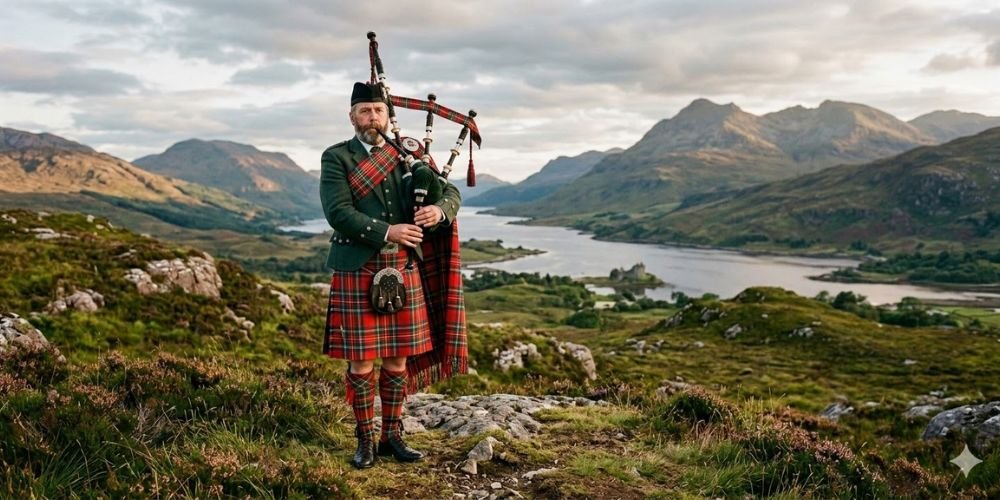
Scots dress for Hogmanay the way Americans dress for Thanksgiving. The occasion earns it. A Royal Stewart tartan kilt at a Hogmanay gathering is not theatrical. It is the right choice for the night, full stop. The pattern is recognized globally. Wearing it on the Scottish new year is simply accurate to the occasion.
For something more formal, a ceilidh, a proper dinner, a celebration that calls for the full picture, a Scottish wedding argyle kilt outfit fits without effort. Hogmanay in Scotland is a night people pull out their best for. The outfit should match that understanding.
What It Actually Asks
American New Year is enjoyable. Nobody is arguing otherwise. But it does not ask anything from the people celebrating it beyond staying awake until midnight.
Hogmanay asks for fire in January. It asks for generosity toward neighbors at the exact time of year when nobody wants to leave the house. It asks for a genuine clearing of the old before the new gets to come in. It asks people to actually mean something when they sing about old friends.
That is harder. It is also considerably more worth doing. For anyone carrying a Scottish surname who has never once looked up what the Scottish new year actually involves, the invitation has been open for a very long time.