
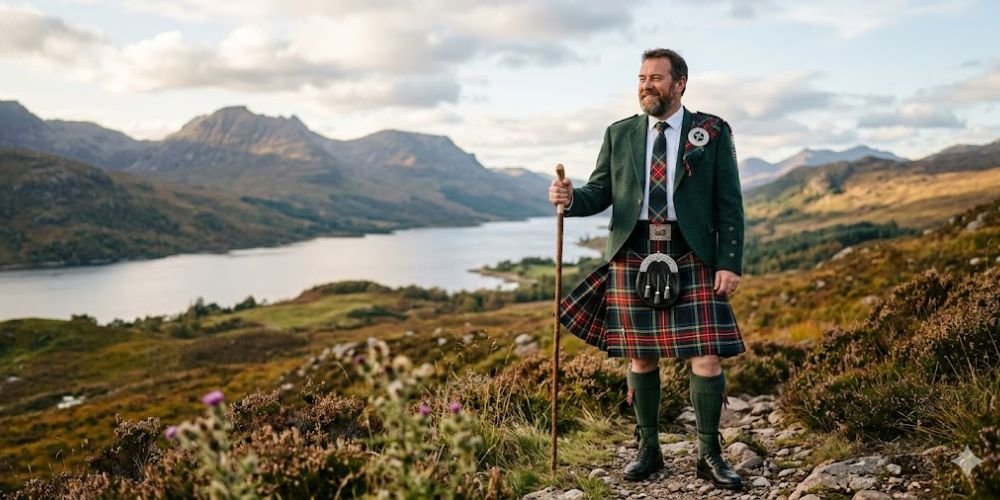
For something that looks like a pattern on fabric, tartan carries a surprising amount of weight behind it. Clan histories, family names, regional ties, centuries of identity woven into a set of crossed lines and colors. That history is part of what makes choosing one feel genuinely difficult, especially for someone standing in front of 14,000 options with no clear starting point.
Most people hit a wall early. They know they want a tartan kilt but have no idea whether they are allowed to wear a specific pattern, whether ancestry matters or what on earth the difference between a “modern” and an “ancient” version of the same tartan actually is. Furthermore, Kilt and Kilts sees this confusion regularly and it almost always comes from the same few misunderstandings.
Why Is Choosing a Tartan So Confusing?
The main issue is that there is no single rule and nobody explains that upfront.
People assume it works like a coat of arms: one per family, strict lines, no exceptions. In reality, tartan comes in layers. Clan tartans exist for family lines. Septs cover surnames that fall under a larger clan. District tartans connect to regions rather than names. Universal tartans are open to everyone. On top of all that, any single tartan can come in five or six different color variations, each with its own name and occasion.
That is a lot of information before a single purchase is made. Breaking it down step by step makes the whole thing far more manageable.
Does Your Surname Have a Tartan?
Start here. Always.
A large number of Scottish surnames connect directly to a clan tartan. MacDonald, Campbell, Fraser, Wallace. They are well-documented names with established patterns that are easy to find and widely available. If the surname is common and Scottish, this step takes minutes.
Where it gets more complex is with less common names or names that are not obviously Scottish. This is where septs come in. Septs are families that, historically, sat under the protection or banner of a larger clan without carrying that clan’s name. Someone named Gibson, for example, may well be connected to Clan Buchanan through exactly this kind of historical tie. A bit of genealogy research, often a single surname lookup can open up a connection that was not obvious at first.
The rule worth remembering: just because a name does not appear in an immediate search does not mean there is no tartan tied to it.
What If There Is No Clan Connection?
Then the options are still wider than most people realize.
District tartans are tied to geography rather than family. Glasgow District, Argyll, the Borders. These patterns belong to areas of Scotland, not surnames. Anyone with a meaningful connection to a region can wear them.
Universal tartans take that even further. Black Watch, Royal Stewart, Flower of Scotland. These belong to no specific family. They were created precisely so that anyone, regardless of ancestry has something to wear with genuine Scottish identity behind it. No clan tie required.
And if none of the above applies? Choosing a tartan based on color preference alone is a perfectly acceptable path. This is not a loophole. It is how many people in Scotland itself choose their kilts.
What Do Tartan Variations Mean?
Finding the right tartan is one thing. Then the color variations arrive and the confusion restarts.
Most tartans come in multiple versions, each with its own look and purpose:
- Modern: The standard version. Bold, saturated colors made possible by synthetic dyes from the 1860s onward. Most clan tartans in shops are the modern version
- Ancient: Lighter, more muted shades that replicate how tartans looked when only plant-based dyes were available. Not older, just styled to look that way
- Hunting: Darker greens and browns built into the pattern for practical outdoor use. Originally worn when discretion in the field mattered
- Dress: Lighter overall, often with white worked into the design. Made for formal Highland events and performance wear.
- Weathered: Faded, earthy tones that simulate years of exposure to the elements. More of a style choice than a historical category
For most buyers, modern is the right starting point. Dress versions suit formal occasions. Hunting works well for outdoor events. Ancient is often a personal preference based on the softer, more antique look.
Does Someone Need to Be Scottish to Wear a Tartan?
The idea that tartan is exclusively for people with Scottish blood is a modern misconception more than a historical reality. Universal tartans exist specifically to be worn by anyone. The tradition has moved well beyond Scotland’s geography, as explored in this piece on which countries wear kilts and how the tradition has spread globally.
A few of the most common ways people connect with tartan outside direct Scottish ancestry:
- Through a maternal or paternal family connection traced back through septs
- Through regional connection to a part of Scotland that has its own district tartan
- Through marriage into a Scottish family
The question of cultural respect in kilt wearing more broadly is also worth reading about this piece on wearing a kilt and what cultural respect actually looks like covers it properly. The short version is that intent and respect matter far more than bloodline.
Where to Find Tartan Kilts Worth Wearing?
Getting the tartan right is the first half of the decision. The second is the kilt itself and the fabric, quality of construction, whether it will hold up across multiple wears.
Men’s tartan kilts cover a wide range of clan and universal patterns for this exact reason.
In fact, those still working out which direction to go will find it worth spending time browsing men’s kilts more broadly before settling on one style.