
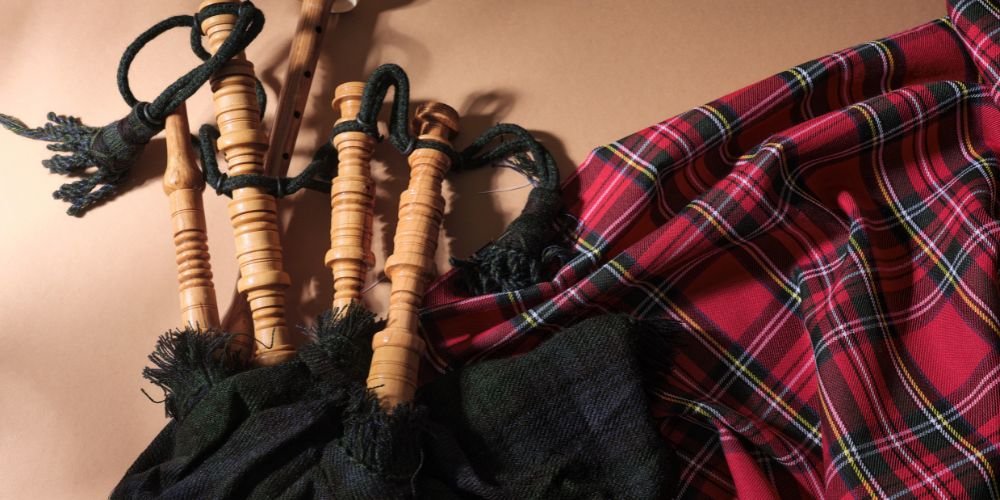
Are bagpipes Irish? Many people of Irish descent ask this because the image of piping often comes up at weddings, funerals and St. Patrick’s Day parades, making it feel deeply Irish. But confusion arises when Scottish Highland bagpipes dominate popular culture. In this article you’ll discover the origins of bagpipes, how they appeared in Ireland and Scotland, and why they remain a symbol of Celtic heritage today. In the same way traditional Highland attire like kilts for men evolved alongside music and ceremony, Irish piping became a hallmark of national identity shaped by history and craftsmanship.
History of Bagpipes
Bagpipes are ancient. Early references to bagpipe‑type instruments appear across Europe, including the Roman Empire and ancient Greece. By the mid‑1500s the Scottish Highland bagpipes were referenced clearly in records and military use. Meanwhile in Ireland, the so‑called “Great Irish Warpipes” or píob mhór show up in historical texts from around 1206 and manuscript art in the 16th century. (per recent research) The instrument evolved through cultural exchange: Scottish regiments adopted them, while Irish pipers maintained local styles. Practices changed through interaction with British military traditions and Celtic folk music alike. The result: a family of bagpipe traditions across Celtic lands.
The Irish Connection to Bagpipes
Ireland’s ties to bagpipes go back to at least the early 13th century. Manuscripts, artwork and accounts show pipers in Ireland using the píob mhór, often in war or ceremony. Later Irish music developed the uilleann pipes that are distinct from the Scottish Highland bagpipes and valued for melodious tone and versatility. The instrument appears at historical milestones: for example, the Irish Citizen Army reportedly used pipes in 1916. Irish musical tradition continues to train pipers in institutions like the Irish World Academy of Music & Dance at the University of Limerick. Thus while bagpipes may be better known as Scottish, they have well‑documented roots and cultural significance in Ireland too. Modern Irish events often celebrate this heritage by pairing traditional piping with men’s tartan kilts, creating a visual and musical link between two intertwined Celtic cultures.
Bagpipes in Irish Culture Today
Today bagpipes are firmly stitched into Irish cultural memory. At weddings, funerals, parades and Gaelic‑football finals you’ll hear piping that echoes centuries of tradition. Music schools across Ireland such as the Willie Clancy Summer School who train pipers in both uilleann and border pipe styles. Modern makers in Ireland produce hand‑crafted sets and musicians experiment by blending electric amplification. The result: bagpipes aren’t museum pieces, they’re alive, evolving and deeply Irish. So when you attend a cultural event or hear that drone, know you’re hearing not just a borrowed instrument, but one that has its own Irish story.
Scottish vs. Irish Bagpipes: Key Differences
Recognising Scottish vs Irish bagpipes starts with construction and sound. Scottish Highland bagpipes are loud, martial and designed for outdoor ceremony; the chanter is fixed, drones dominate and the scale is limited. Irish instruments such as the uilleann pipes offer quieter, indoor‑friendly tone, full chromatic range and bellows‑driven air supply, enabling melodic complexity. Cultural usage differs too: Scottish pipes were historically clan and military instruments; Irish pipes often accompanied social gatherings, dance and civil ceremony. The different contexts shaped the style. Modern practitioners and makers like the National Piping Centre in Glasgow and Pipers’ Alley in Dublin focus on the these distinctions for authenticity.
Conclusion
While bagpipes are commonly associated with Scotland, the evidence shows Ireland holds a strong and distinct piping tradition too. The instrument’s journey through Ireland, from the píob mhór to the uilleann pipes, reflects cultural adaptation, innovation and heritage. For Irish‑heritage families seeking connection, it offers more than borrowed symbolism and offers legacy. Next time you ask “Are bagpipes Irish?”, you can answer with confidence:”yes”. And that they carry their own unique Irish story.
For enthusiasts who love both Irish and Scottish heritage, we at KiltsandKilts celebrate this shared culture by offering authentic tartan kilts, accessories, and piping gear that honor both traditions. Make sure to check it out.